
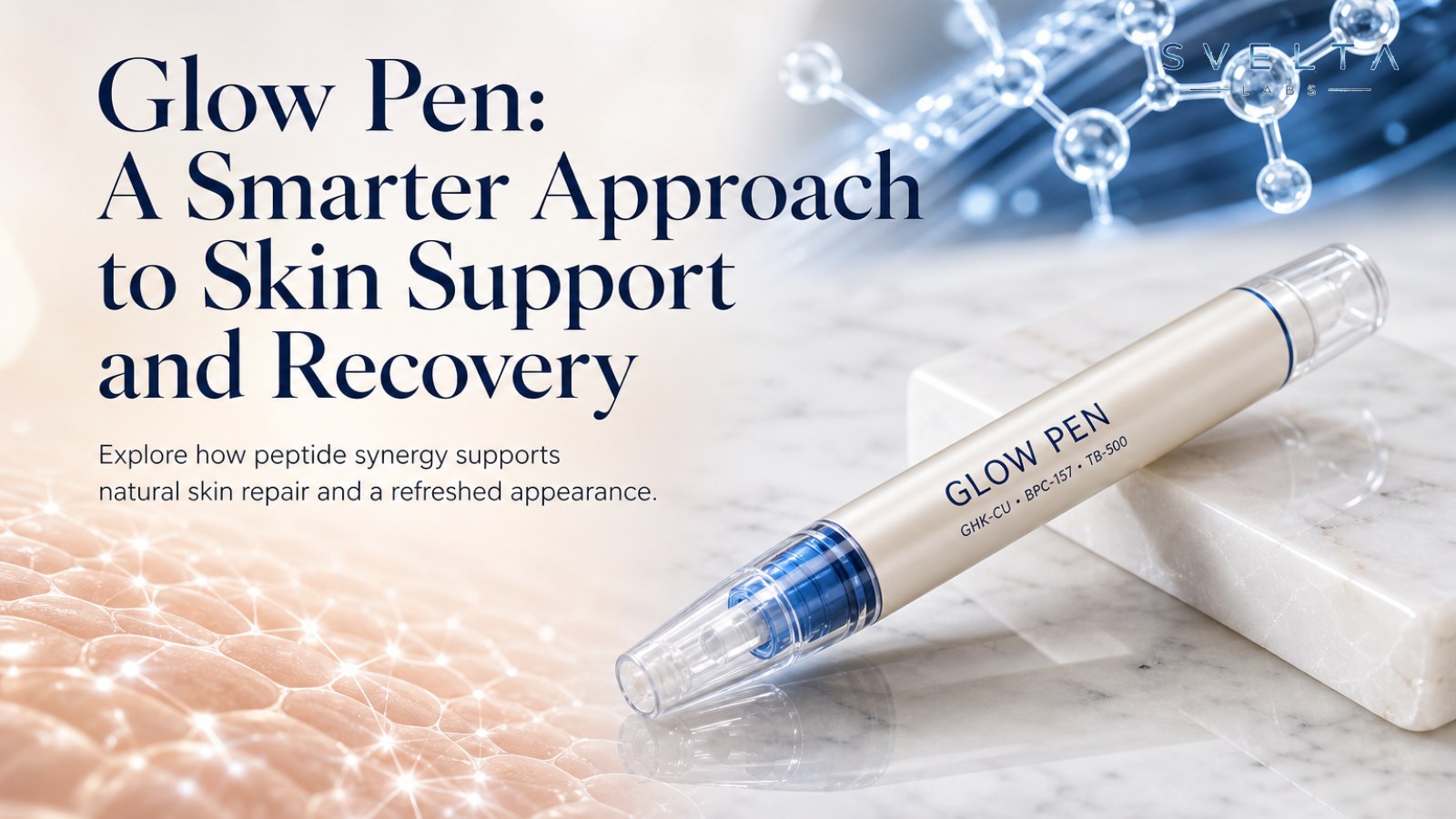
The Svelta Labs Glow peptide pen listing names three ingredients: GHK-Cu, BPC-157 and TB-500. Knowing that list helps identify the product. It does not establish a skin-repair or recovery benefit for the combined formulation.
GHK-Cu: ingredient research is not a product trial
GHK-Cu is a copper-binding tripeptide. Published laboratory work has examined collagen synthesis in fibroblast cultures. A cell-culture observation does not show that a pen containing GHK-Cu produces the same outcome in people.
BPC-157 and TB-500: keep the evidence separate
BPC-157 and TB-500 are discussed in tissue-repair research and marketing, but those discussions should not be converted into claims that this blend heals injuries or improves skin. In its compounding safety information, the FDA identifies important gaps in human safety information for these substances.
Names also require care. The FDA identifies TB-500 as a thymosin beta-4 fragment. Evidence about a differently specified material or full-length thymosin beta-4 should not be assumed to apply to an unspecified product called TB-500.
Why a combination needs its own evidence
Putting three ingredients into one preparation creates a different research question from studying each alone. Claims that the ingredients work together, are more effective in combination or produce a refreshed appearance need evidence for that formulation. No such result is established by this article.
- Check the exact ingredient list and any stated amounts.
- Look for documentation specific to the finished formulation.
- Separate product identity from purity, stability and clinical evidence.
- Do not interpret the word Glow as a guaranteed cosmetic outcome.
Read the current Glow Pen product information and the GHK-Cu research explainer. The listed product is presented for research use, not human consumption.
Sources: Maquart et al., FEBS Letters, 1988, PMID 3169264; FDA compounding safety information. The current ingredient statement comes from the Svelta product listing, not an independent assay. More education is available at Svelta Labs.
Sources
Maquart et al., GHK-Cu primary study: https://pubmed.ncbi.nlm.nih.gov/3169264/
FDA compounding safety information: https://www.fda.gov/drugs/human-drug-compounding/certain-bulk-drug-substances-use-compounding-may-present-significant-safety-risks