
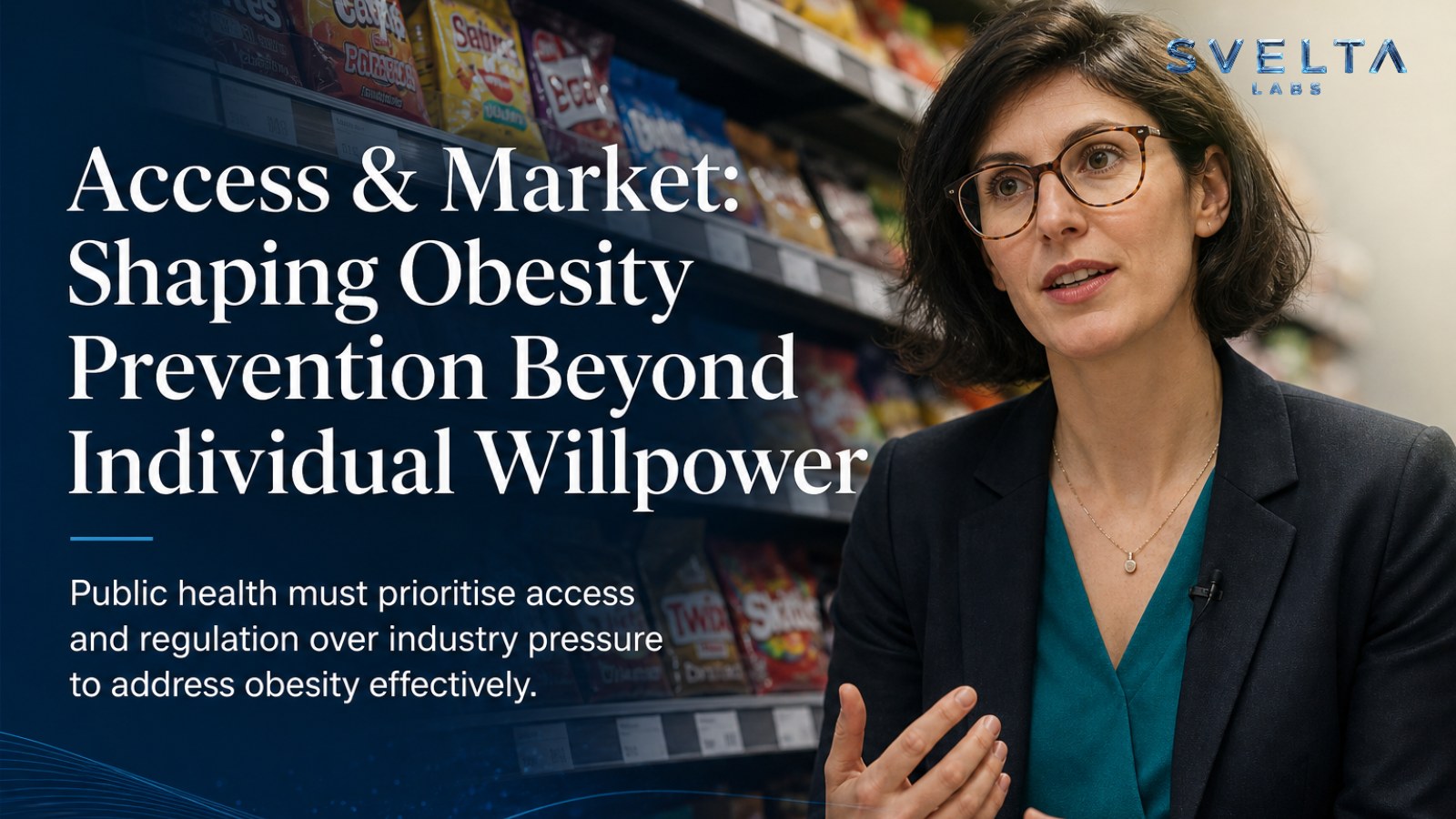
Obesity prevention depends partly on the food environment: the prices, promotions and places that shape everyday choices. The Health and Social Care Committee’s July 2026 report argues for stronger action on those conditions. Its recommendations are proposals for government, not a list of measures already in force.
Food markets and the choices people can make
The Food and Weight Management: Fixing the food environment report argues that businesses with commercial interests in less healthy food should not shape obesity policy in ways that undermine public health. The underlying issue is a conflict between sales incentives and prevention, rather than a judgement about individual shoppers.
The committee’s accompanying statement cites an estimated annual UK cost of £74.3 billion, including £11.4 billion to the NHS. These are attributed estimates, not a calculation made by Svelta Labs. They help explain the report’s emphasis on prevention alongside treatment.
Proposed healthier-sales and advertising measures
- Mandatory reporting on the healthiness of food sales, with targets for supermarkets and the wider food industry.
- Effective enforcement of those targets, including proposed financial penalties.
- Further restrictions on outdoor advertising of less healthy food.
- Stronger practical support for local action on the food environment, including planning around fast-food outlets.
The committee presents these as ways to change the conditions in which food choices happen. Their final design, legal status and implementation dates must be checked separately; a recommendation in a report does not itself create an advertising ban or a fine.
Prevention, access and weight-management treatment
Access to nutritious food, time, income and local facilities differs between communities. A policy that encourages healthier choices should therefore be assessed for affordability and reach as well as its overall effect. Treatment and prevention can be considered together without reducing obesity to willpower or treating medication as a substitute for a healthier food environment.
The report gives this debate a concrete set of proposals to examine. Evaluation should ask whether changes improve food affordability and population health, and whether benefits reach those facing the greatest barriers. Further Svelta Labs education is available at https://sveltalabs.com.
This article is for educational purposes only and does not provide medical advice or treatment recommendations. Research on obesity prevention and related interventions is evolving, and individual health decisions should be made in consultation with qualified professionals.
Sources
House of Commons Health and Social Care Committee: Food and Weight Management report, July 2026: https://publications.parliament.uk/pa/cm5902/cmselect/cmhealth/223/report.html.
UK Parliament: Health and Social Care Committee report announcement: https://committees.parliament.uk/committee/81/health-and-social-care-committee/news/214888/stand-up-to-food-industry-after-decades-of-failure-to-tackle-obesity-epidemic-mps-tell-government/.